OFF-CLOCK
Mapping the Systems Behind Volunteer Engagement in NGO Schools
An exploration of volunteer recruitment and retention challenges within educational NGOs. Through field research, interviews and systems-thinking techniques like causal mapping, the Iceberg Model and Five Whys, I uncovered underlying issues and opportunities to build a more sustainable volunteer ecosystem.
My Focus
· Field Research & Data Analysis · System-Level Ideation · UX Research & Interface Design
Duration — 2 week | Year — 2024
Tools used

Educational NGOs
play an important role in creating access to learning and opportunities for children from underserved communities. However, their functioning extends far beyond classrooms, involving a network of students, educators, volunteers, donors, resources and community stakeholders.
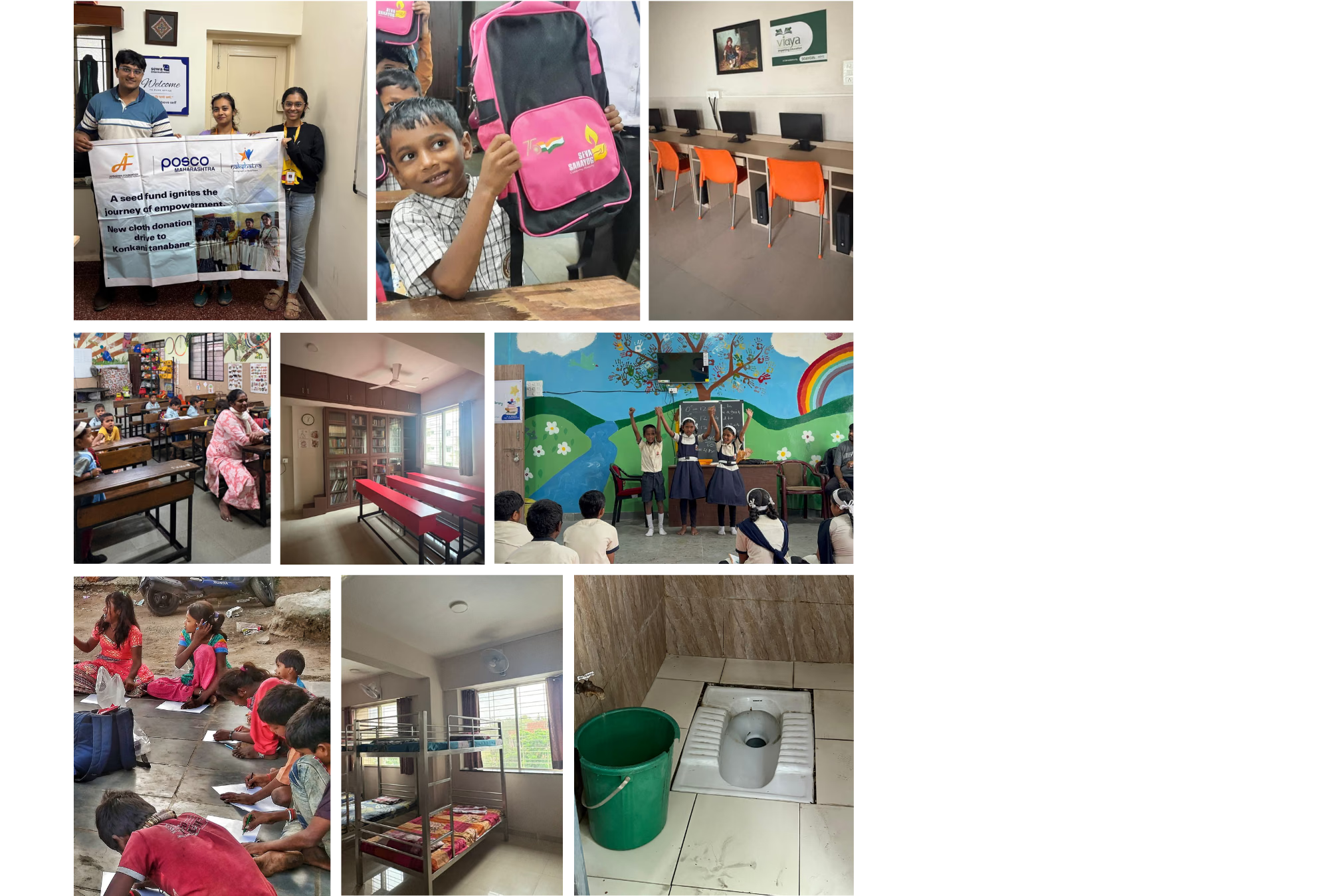
Visited seven educational NGOs across Pune, along with private and government schools, to compare learning environments, teaching approaches and infrastructure. The NGO visits further helped to understand their educational practices, operational structures and community engagement.
Key Field Observations
Diverse Approaches to Education
Formal schooling, bridge education, informal learning and skill-based programmes.
Formal schooling, bridge education, informal learning and skill-based programmes.
Learning Beyond Academics
Mentorship, creative activities, life skills and socio-emotional development.
Uneven Resources & Support Systems
Differences in infrastructure, funding, partnerships and operational capacity.
Volunteer Roles & Continuity
Different levels of volunteer involvement, training and long-term participation.
Research methods
Field visits · Direct observation · Interactions · Visual documentation
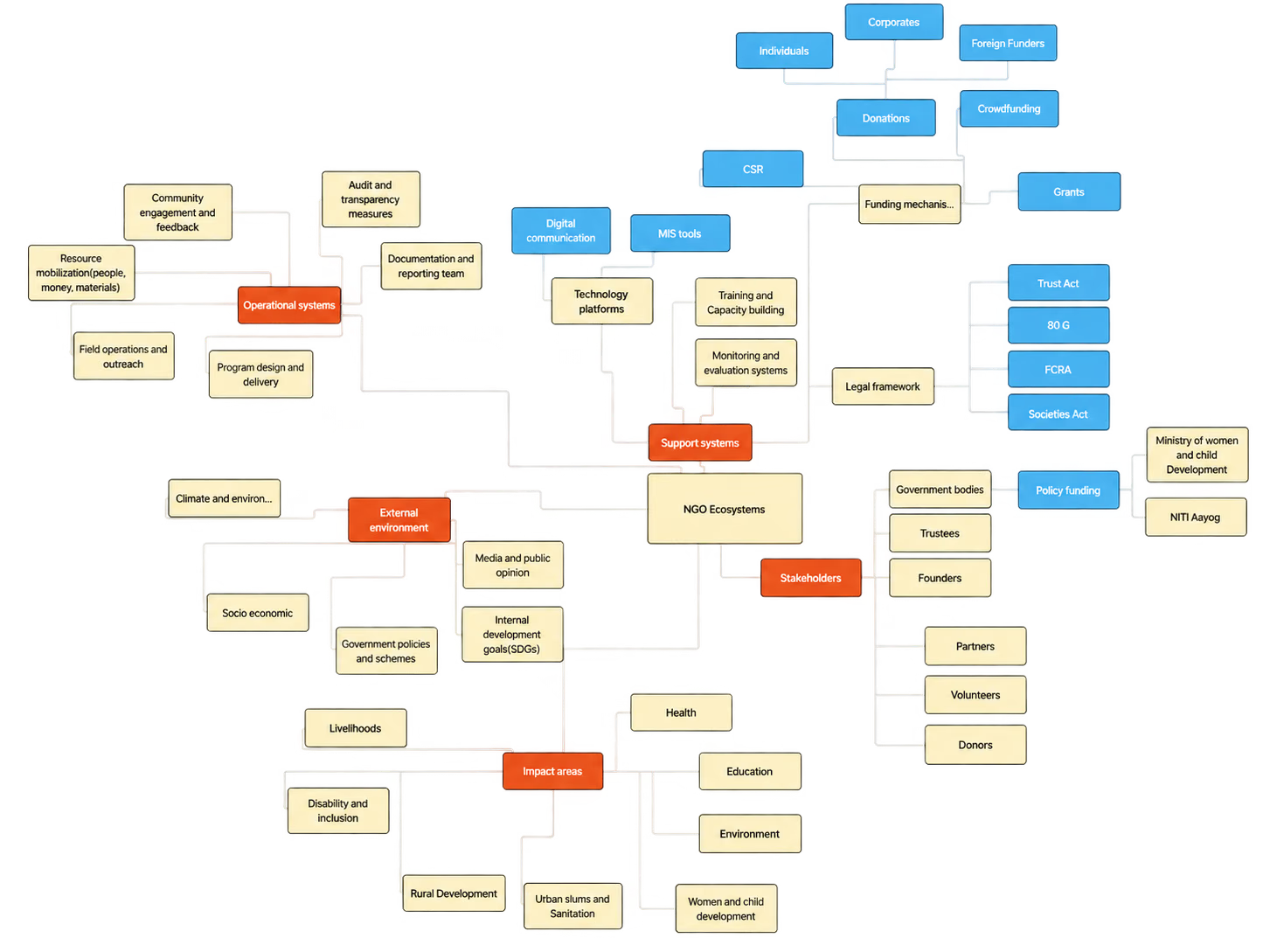
Mapped the broader NGO ecosystem to understand the different elements that influence how these organisations function.
LOOKING BENEATH THE SURFACE
Applying the Iceberg Model
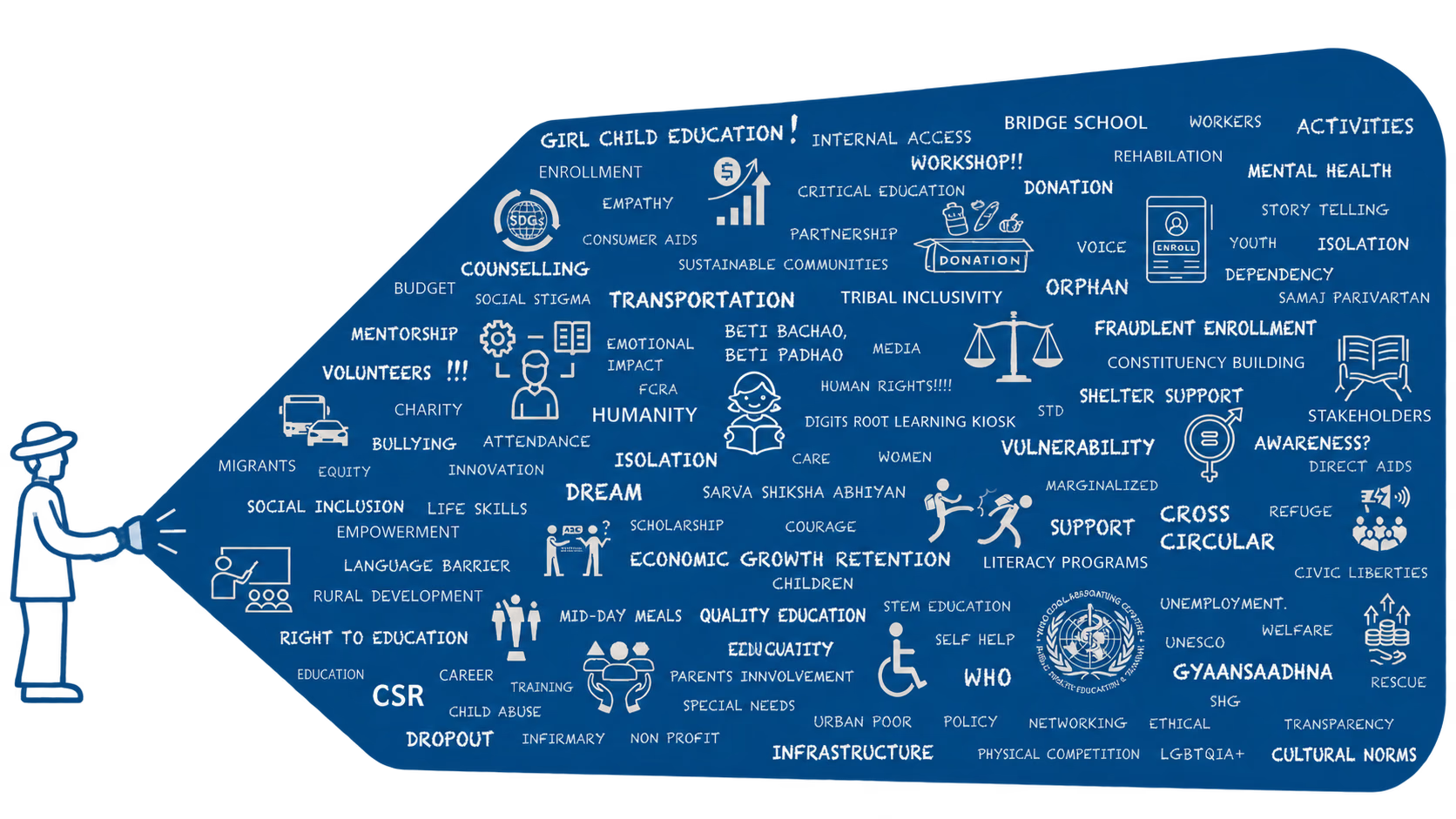
After mapping the larger NGO ecosystem, we recognised that several challenges were interconnected and could not be understood through visible incidents alone.
What the framework helped me investigate
Visible events Recurring patterns System structures Mental models
Visible events Recurring patterns System structures Mental models

Events - Students dropping out from educational institutions
Patterns | What keeps happening?
Student dropouts between primary and secondary education, irregular attendance and gaps in learning.
Student dropouts between primary and secondary education, irregular attendance and gaps in learning.
Structures | What is causing these patterns?
Language barriers, difficulty adapting to academic expectations, peer influence and declining motivation.
Language barriers, difficulty adapting to academic expectations, peer influence and declining motivation.
Mental Models | What beliefs influence the system?
Education is not necessary for girls". "He wont learn anyways, why waste money". "My child needs to earn not read books". "Children from poor background want succeed anyway". "English is the only way to succeed" Schooling is only made rich
Education is not necessary for girls". "He wont learn anyways, why waste money". "My child needs to earn not read books". "Children from poor background want succeed anyway". "English is the only way to succeed" Schooling is only made rich
Events - Ongoing efforts to recruit volunteers
Patterns | What keeps happening?
Seasonal recruitment drives, social media outreach and college partnerships. High initial participation then volunteer shortages and declining engagement.
Seasonal recruitment drives, social media outreach and college partnerships. High initial participation then volunteer shortages and declining engagement.
Structures | What is causing these patterns?
Over reliance, non structured, no follow ups, inadequate training, non formalized, unrealistic expectation, lack of female, internal commitment, external motivation, paid support, no family or peer support, personal commitment
Over reliance, non structured, no follow ups, inadequate training, non formalized, unrealistic expectation, lack of female, internal commitment, external motivation, paid support, no family or peer support, personal commitment
Mental Models | What beliefs influence the system?
"Volunteers are temporary dont expect much". "Volunteers = extra help not essential work". "Volunteers is equal to free labor". "Good people volunteer and good people say no". "Someone else will handle it".
"Volunteers are temporary dont expect much". "Volunteers = extra help not essential work". "Volunteers is equal to free labor". "Good people volunteer and good people say no". "Someone else will handle it".
Events - Students are motivated to go for NGO Sessions
Patterns | What keeps happening?
Increase in attendence, social intraction skills, one to one volunteer interaction , children feel emotionly and physically safer, increase in recognition of students
Increase in attendence, social intraction skills, one to one volunteer interaction , children feel emotionly and physically safer, increase in recognition of students
Structures | What is causing these patterns?
Easy to join, no uniform , exposure to co-curricular activity , value education, community involvement, celebrating small achievement, non traditional evaluation method
Easy to join, no uniform , exposure to co-curricular activity , value education, community involvement, celebrating small achievement, non traditional evaluation method
Mental Models | What beliefs influence the system?
"Traditional school are rigid and not engaging". "Children can learn better if taught with care and empathy" "i learn more here than regular school" "Education can help me change my future". "we are not judged & punished here" "i can ask question without fear"
"Traditional school are rigid and not engaging". "Children can learn better if taught with care and empathy" "i learn more here than regular school" "Education can help me change my future". "we are not judged & punished here" "i can ask question without fear"
CONNECTING THE DOTS
The Iceberg analysis helped to identify deeper issues within the NGO ecosystem. Volunteer engagement emerged as an area worth exploring further.
Mapped the relationships between recruitment, motivation, training, satisfaction and retention to understand how one factor could influence another.
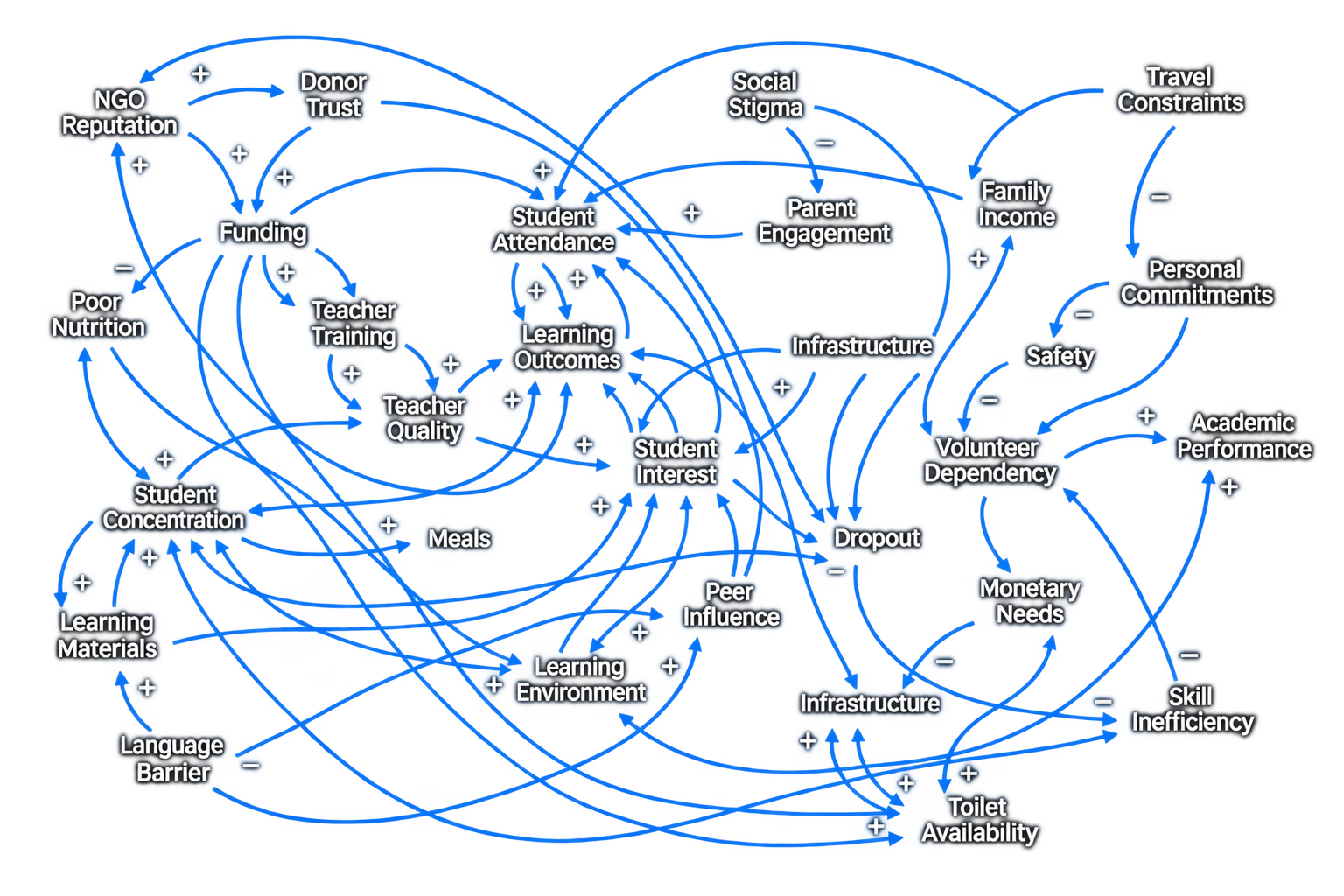
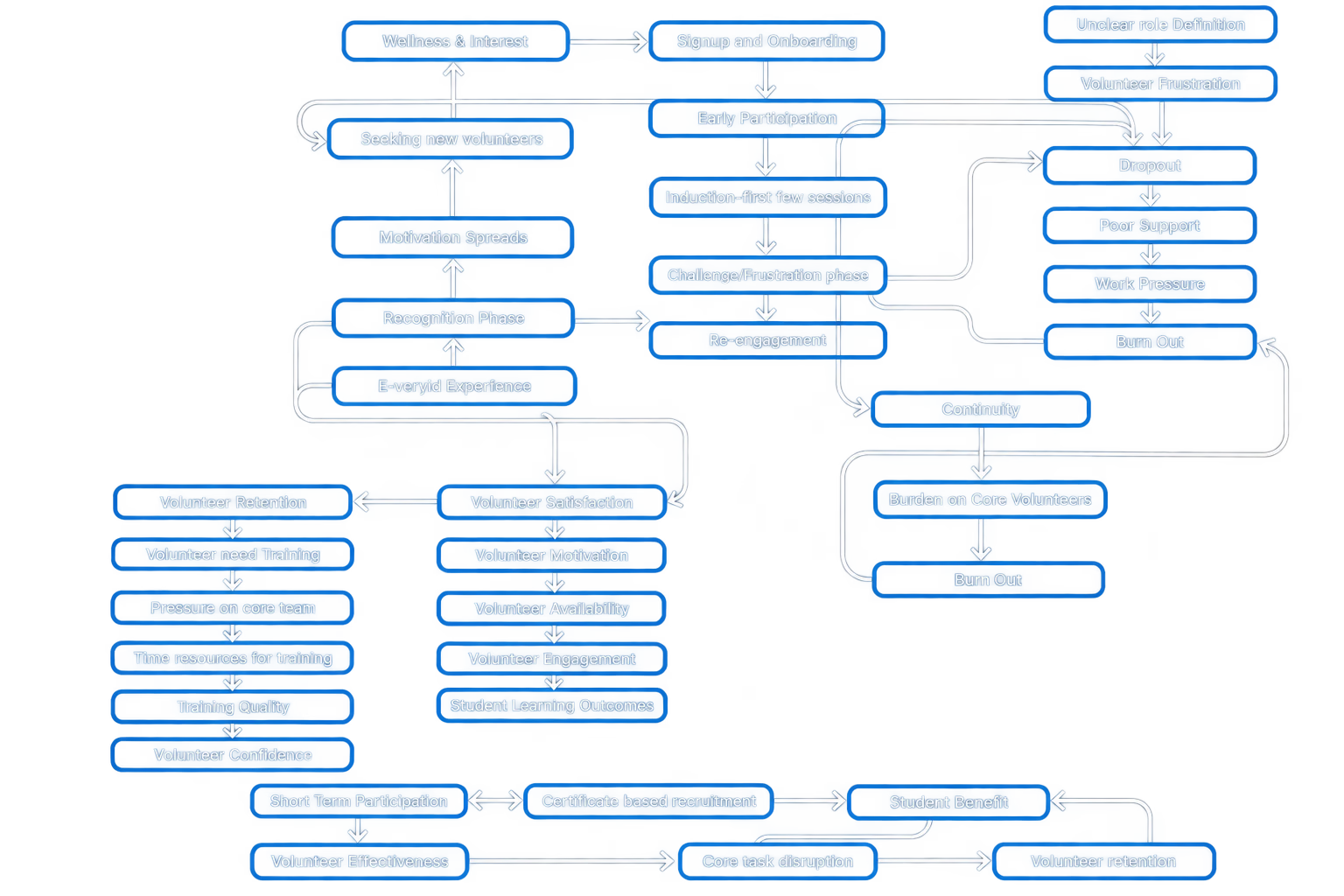
Leverage point - By addressing volunteer interest degradation, we can begin to resolve deeper issues such as leadership gaps, weak infrastructure, limited growth opportunities, and social disconnection. This, in turn, strengthens the overall effectiveness of the NGO.
Pain points
01 Frequent drop-offs after initial participation.
08 Reluctance to travel long distances for volunteering
02 Low public awareness (about NGO volunteering opportunities)
09 Volunteering driven by desire for certificates or personal gain
03 Lack of structured outreach or recruitment strategies
10 Frequent drop-offs fading interest
04 Insufficient incentives (to attract or retain volunteers)
11 Limited visibility of the NGO’s impact or success stories
05 Minimal opportunities for personal growth or skill development
12 Poor communication between NGOs and potential volunteers
06 Perception that volunteering requires high effort with low return
13 Lack of flexible volunteering (options to suit varied schedules and lifestyles)
07 Training overload and skill mismatch
5 why analysis
Frequent drop-offs after initial participation
Training overload and skill mismatch
Why do they participate short term?
They volunteer in their free time.
They volunteer in their free time.
Why do volunteers lack the required skills?
Diverse backgrounds and limited experience.
Diverse backgrounds and limited experience.

Why only in free time?
Academic schedules limit availability.
Academic schedules limit availability.
Why does limited availability lead to drop-offs?
Inflexible schedules disrupt continuity.
Inflexible schedules disrupt continuity.
Why is continuity difficult to maintain?
Lack of regular follow-ups and engagement.
Lack of regular follow-ups and engagement.
Why are volunteers not consistently re-engaged?
Limited communication, recognition and relationship-building.
Limited communication, recognition and relationship-building.

Why is their experience not identified?
No skill assessment before role assignment.
No skill assessment before role assignment.
Why are unsuitable roles assigned?
Recruitment prioritises numbers over skill alignment.
Recruitment prioritises numbers over skill alignment.
Why is skill alignment not addressed through training?
Training is generic, not role-specific.
Training is generic, not role-specific.
Why is training not role-specific?
Limited resources and no structured programmes.
Limited resources and no structured programmes.
Reluctance to travel long distances for volunteering
Frequent drop-offs after initial participation
Why do volunteers face challenges?
Long travel and scheduling conflicts.
Long travel and scheduling conflicts.
Why does excitement fade?
activities stop feeling engaging.

Why are travel and scheduling an issue?
Limited time, money and public transport dependency.
Limited time, money and public transport dependency.
Why are these constraints difficult to overcome?
NGO locations and timings mismatch volunteer availability.
NGO locations and timings mismatch volunteer availability.
Why is volunteer allocation inflexible?
Fixed school schedules and limited flexibility.
Fixed school schedules and limited flexibility.

Why not engaging?
tasks become repetitive and mismatched.
Why mismatched?
volunteer interests aren't understood well.
Why not understood?
poor onboarding and communication.
Why is flexibility not considered?
Travel constraints and availability overlooked during planning.
Travel constraints and availability overlooked during planning.
Why poor onboarding?
ngos lack resources for volunteer management.
PROBLEM STATEMENT
Educational NGOs depend on committed volunteers to create lasting social impact, yet volunteering often remains a short-term, inconsistent experience as people struggle to find opportunities that align with their interests, skills and availability, while NGOs' limited flexibility, structured guidance and recognition make sustained participation difficult.
How might we increase long term commitment of volunteers for NGO’s so that social and emotional impact strengthens?

Volunteer Demographics
Higher volunteer participation among women.

Gender | 61.7%

Stronger volunteer base in urban and Tier 1–2 regions.
Urban–Tier Distribution | 69%

Young adults and students form an important volunteer segment.
Age | 40%

Potential volunteers lack awareness of where and how to contribute.
Lack of Awareness | 70%
Reasons and Motivations

Career Benefits
Passion for a cause
Exposure & Experience
Emotional Fulfilment
Social Connection
Existing Volunteer Models



01. Make A Difference (MAD)
04. Open World Learning (OWL)



Known for: Structured, long-term mentorship programmes for underprivileged children.
Known for: Hands-on, inquiry-based learning and long-term volunteer engagement.
Key learning: Structured mentorship
Key learning: Continuous learning

03. AIESEC
Known for: International volunteering and cultural exchange programmes aligned with the UN SDGs.

Key learning: Training and cultural exposure
05. iSPiiCE

02. Goonj

Known for: Community-driven initiatives in education, women's empowerment and sustainability.
Known for: Community-led development through initiatives addressing clothing, education and sanitation.
Key learning: Meaningful community participation
Key learning: Practical skill development
WHAT CAN MAKE VOLUNTEERING SUSTAINABLE?
What we learned
Across the volunteer models studied, a few recurring factors stood out:
01. Structured Engagement
Clear roles and organised onboarding.
Clear roles and organised onboarding.
02. Meaningful Participation
Opportunities to contribute to a cause.
Opportunities to contribute to a cause.
03. Personal Growth
Skill development and practical experience.
Skill development and practical experience.
04. Continued Connection
Recognition, community and ongoing engagement.
Recognition, community and ongoing engagement.
The Gap
While existing models offer effective ways to engage volunteers, discovering relevant opportunities, finding the right fit and maintaining involvement can still be challenging.
Identified Design Opportunity
Connecting professional networks with purposeful volunteering.
Explore how LinkedIn’s existing professional ecosystem could be extended to help people:

• Discover relevant NGO volunteering opportunities.
Align their skills and interests with volunteer roles.
Build sustained engagement through continued involvement.
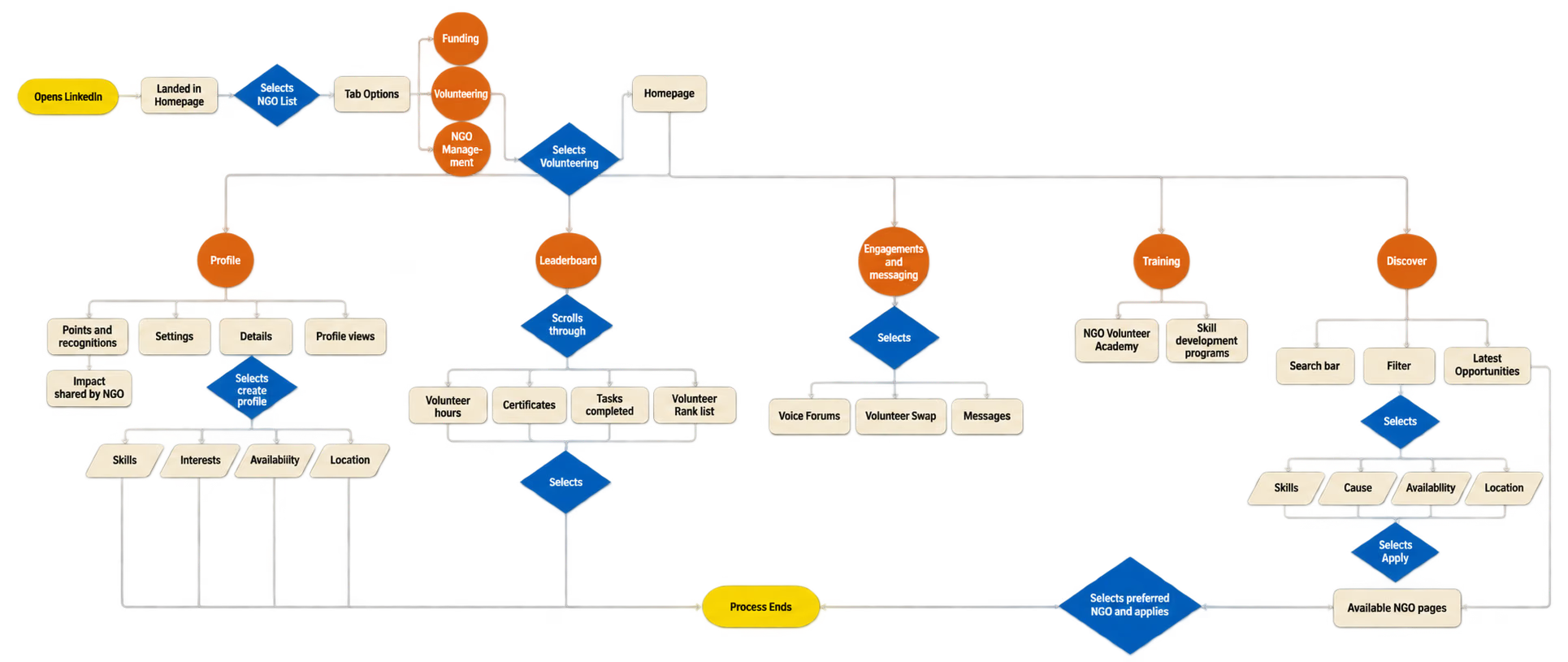
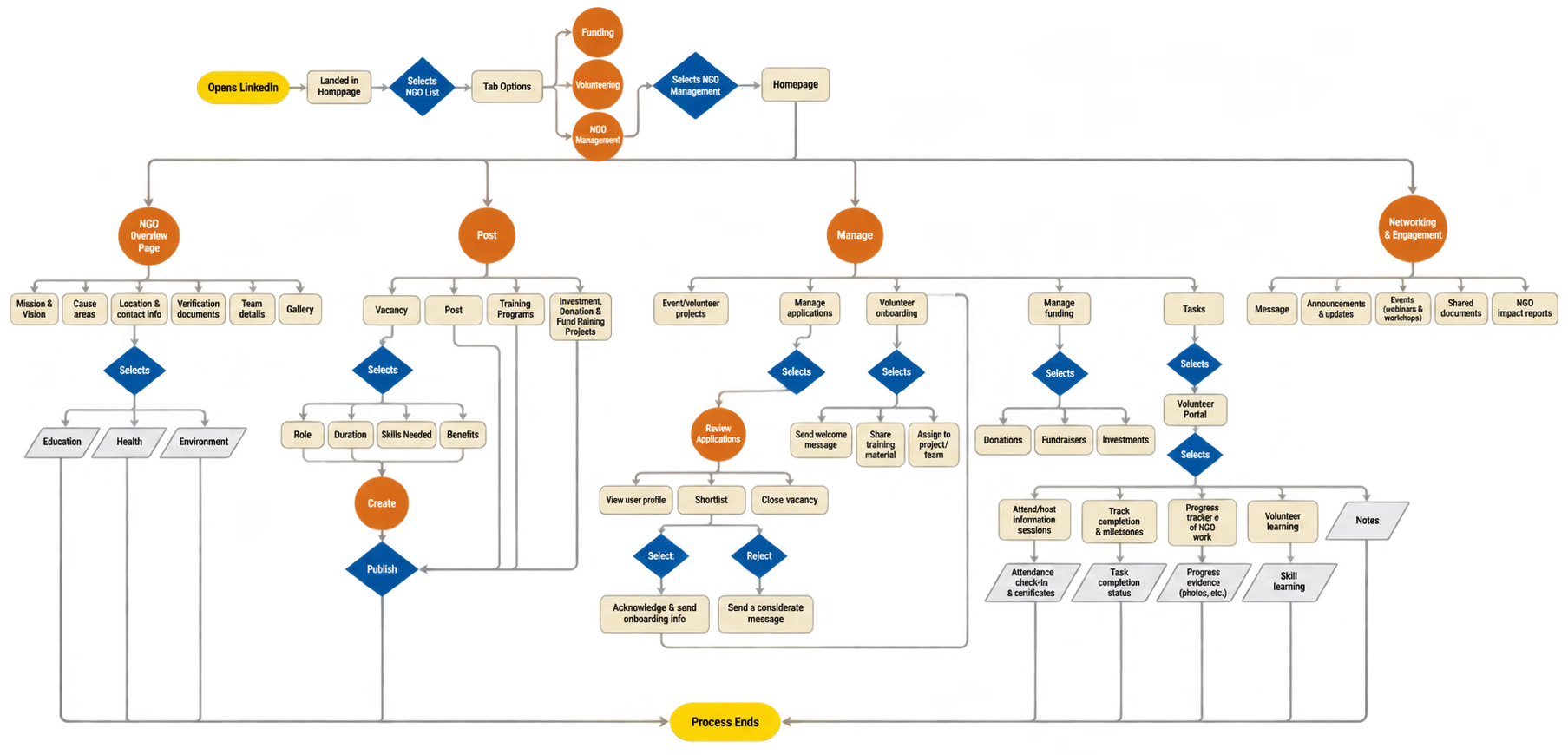
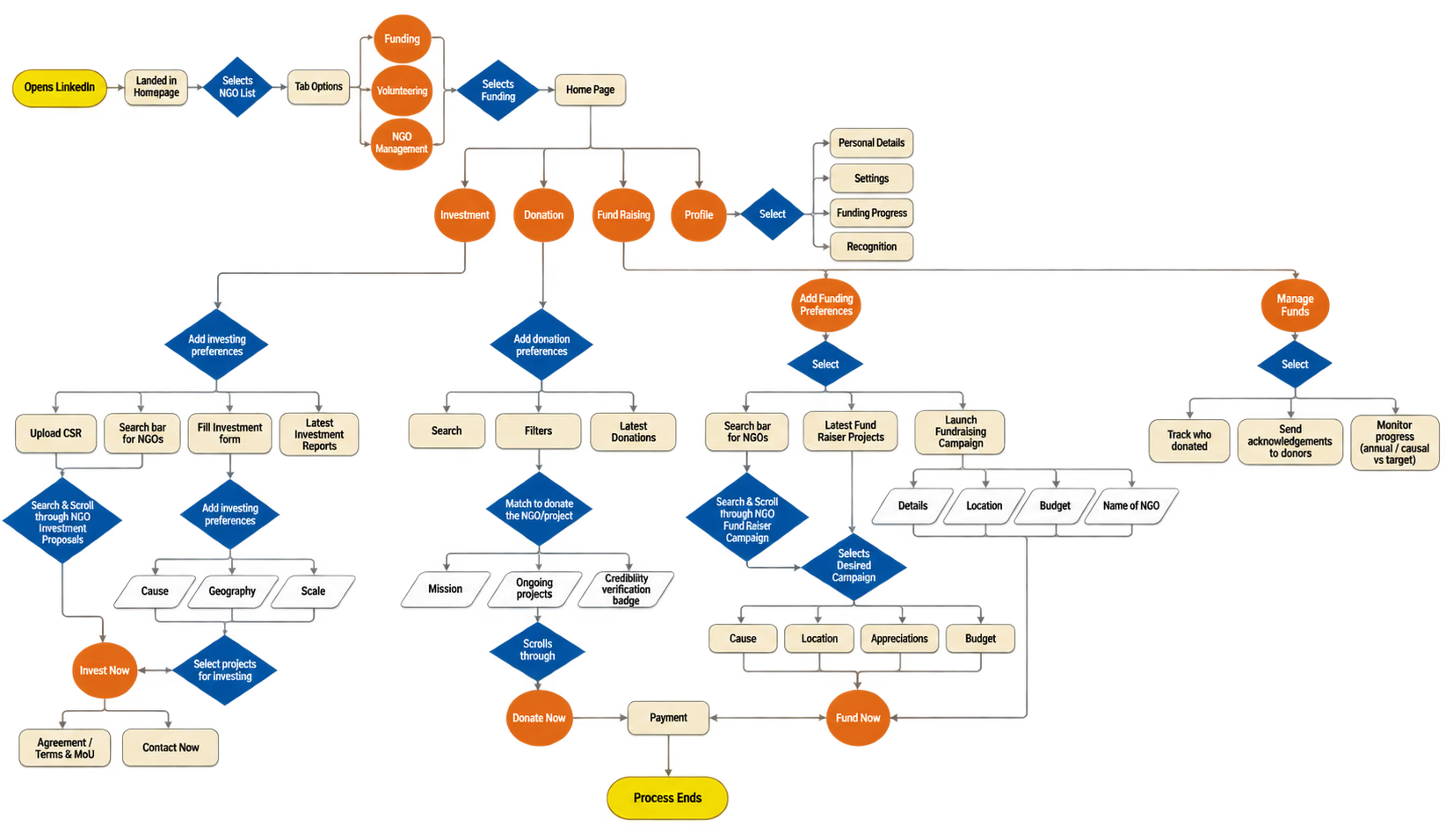
TASK FLOWS
01. For Volunteering
02. For Managing a NGO
03. For Fundraising in a NGO
PROTOTYPING
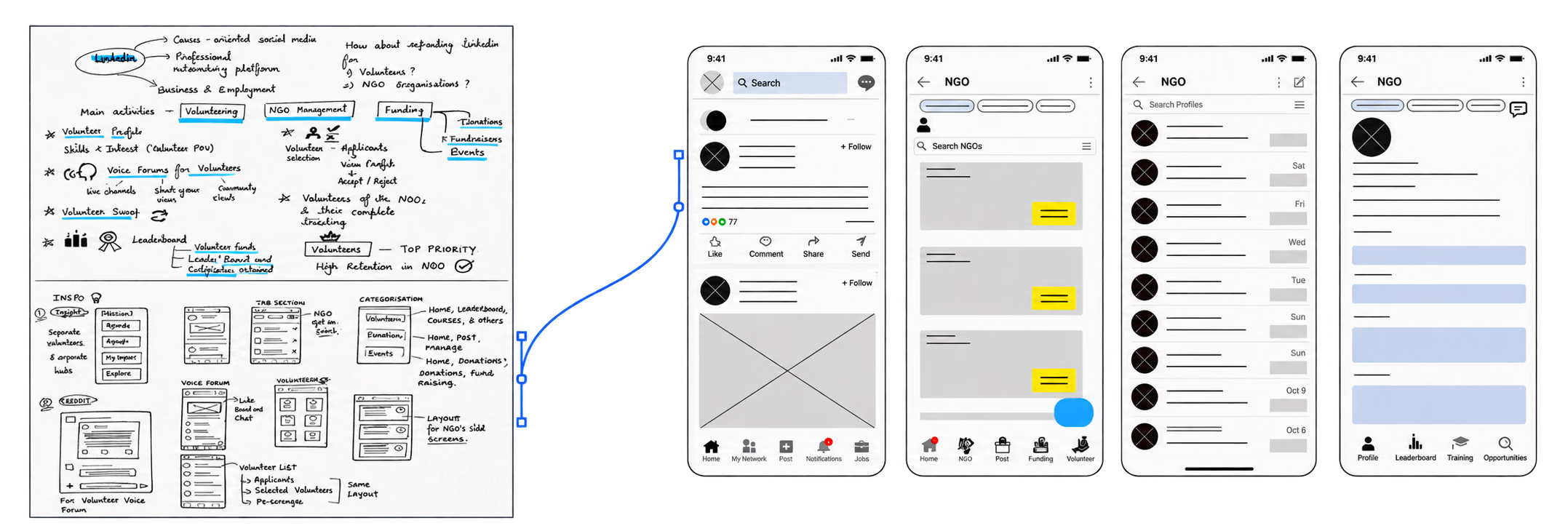
Planning and Sketching
Wireframes
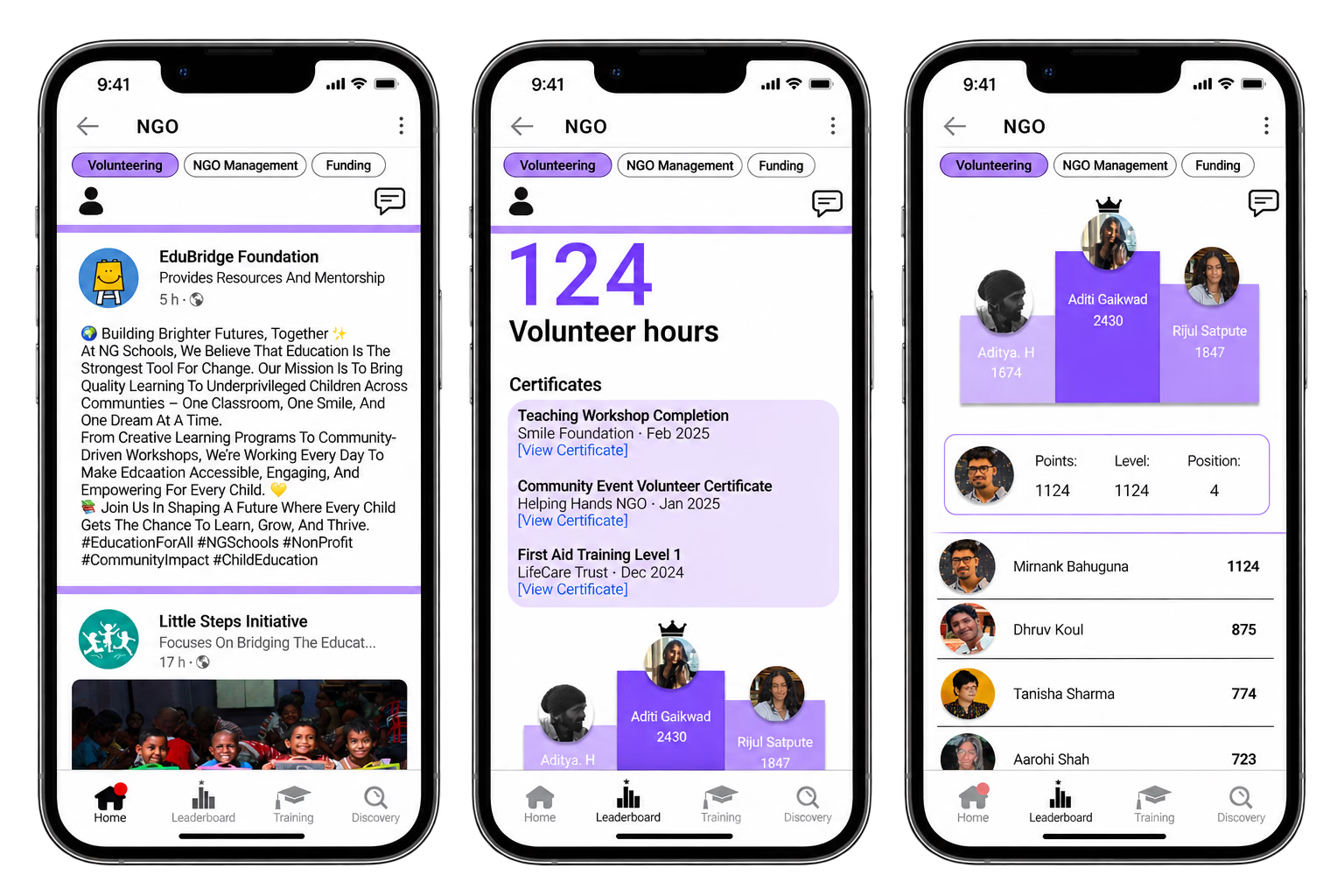
High Fidelity Screens
Getting started

Volunteering
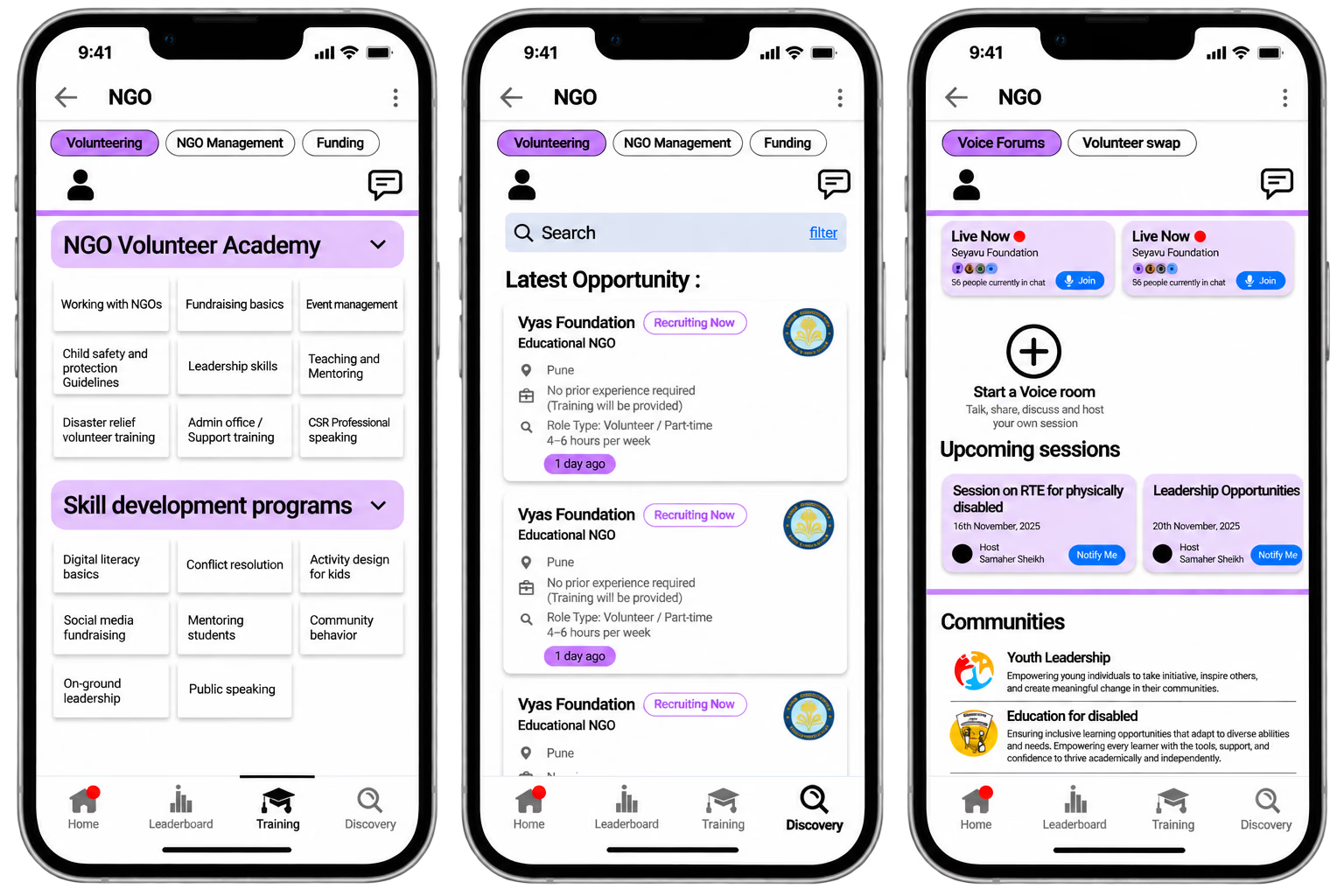
Training sectioning helps you take courses on various skills that your volunteering role might need. Suggested by LinkedIn and NGO's
Helps you find volunteering opportunities
This is a volunteer forum (accessed from chat section) where you can join channels, converse with multiple NGO heads or other volunteers through the live calls and chats.
You can also start your own voice room.
You can also start your own voice room.
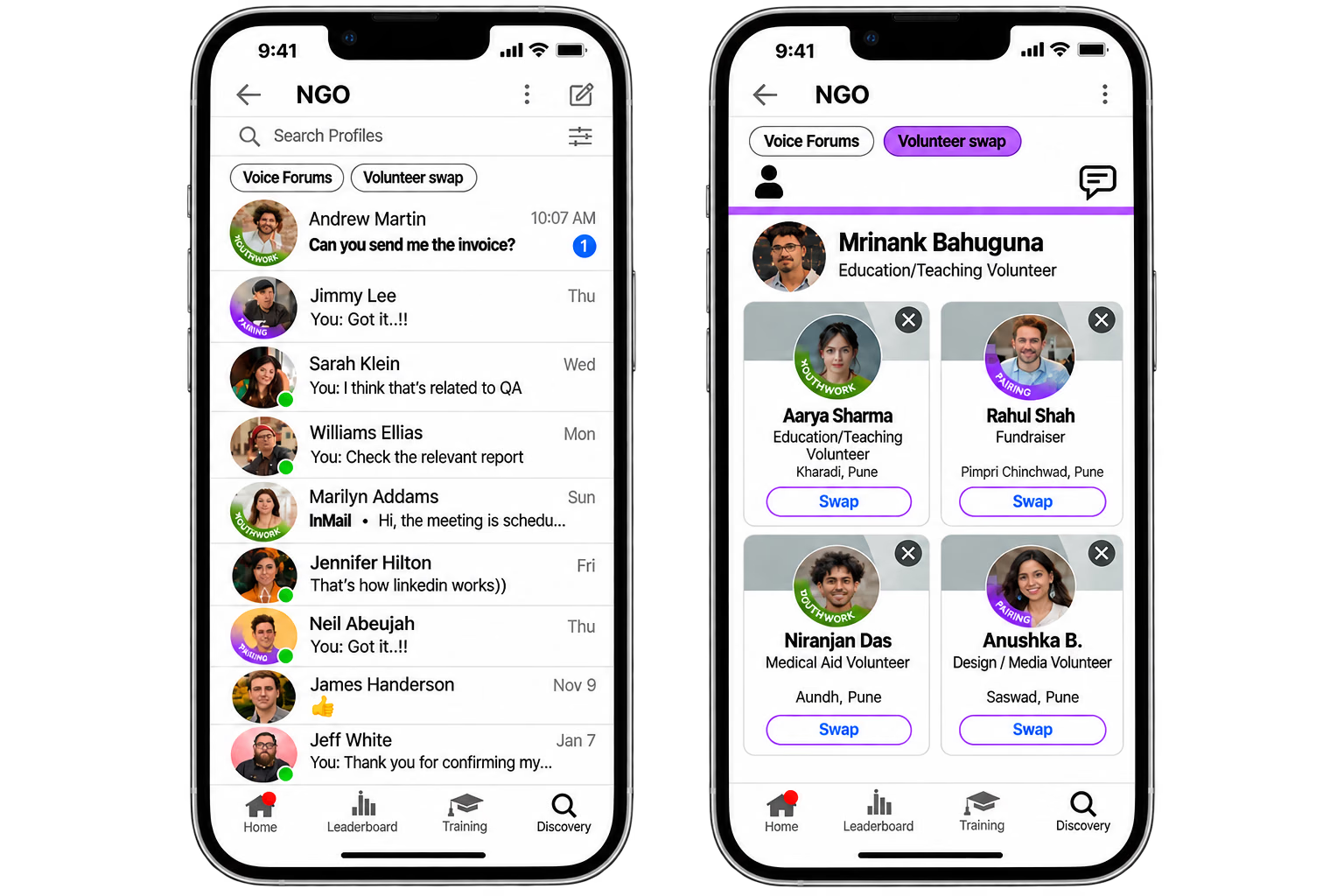
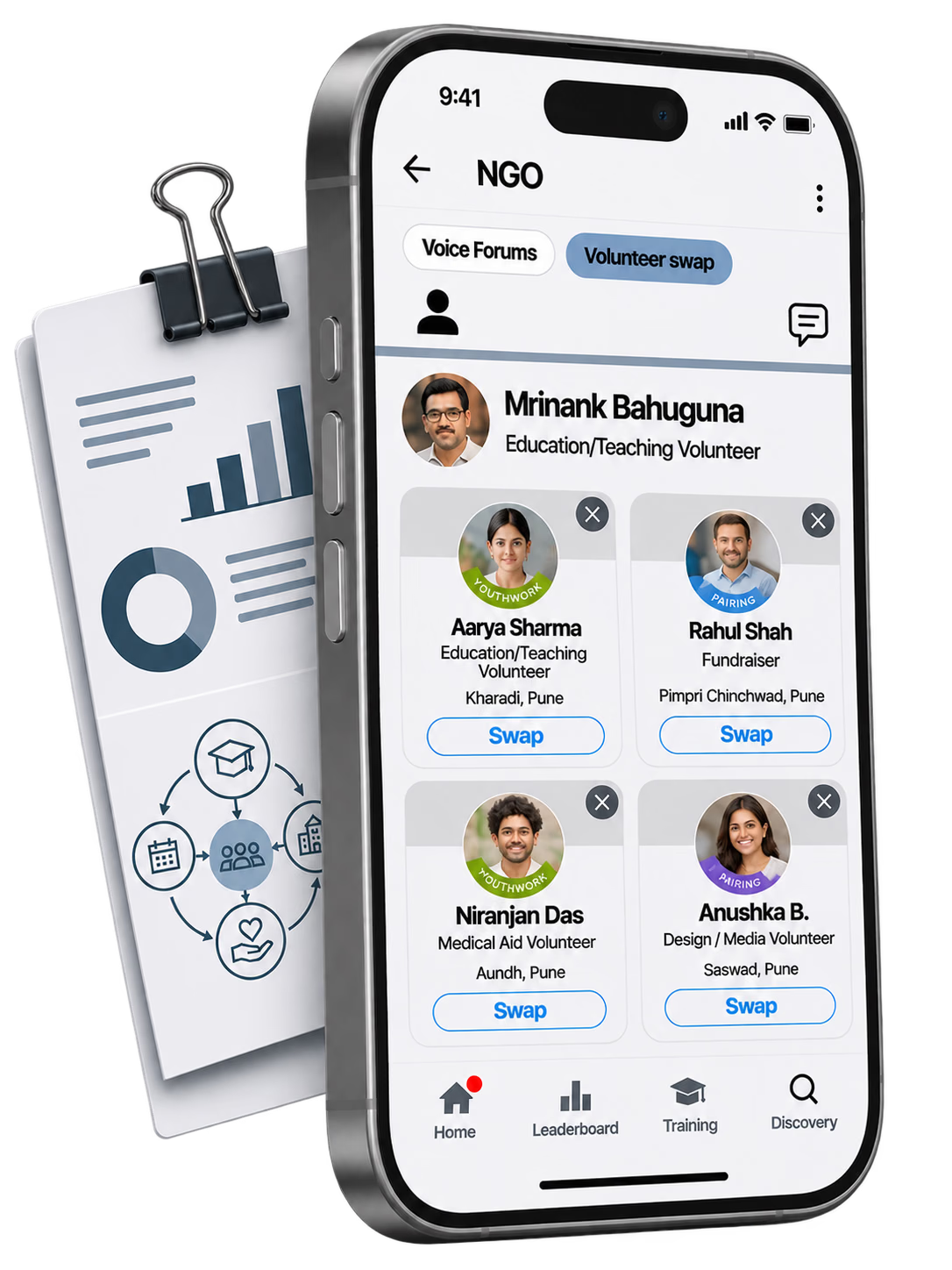
Have conversations with your NGO team or anybody whom you connected to swap
This feature lets you swap with any other volunteer who is interested in your role in case you can't work for a few days or are unable to go to any site for volunteer work
NGO Management
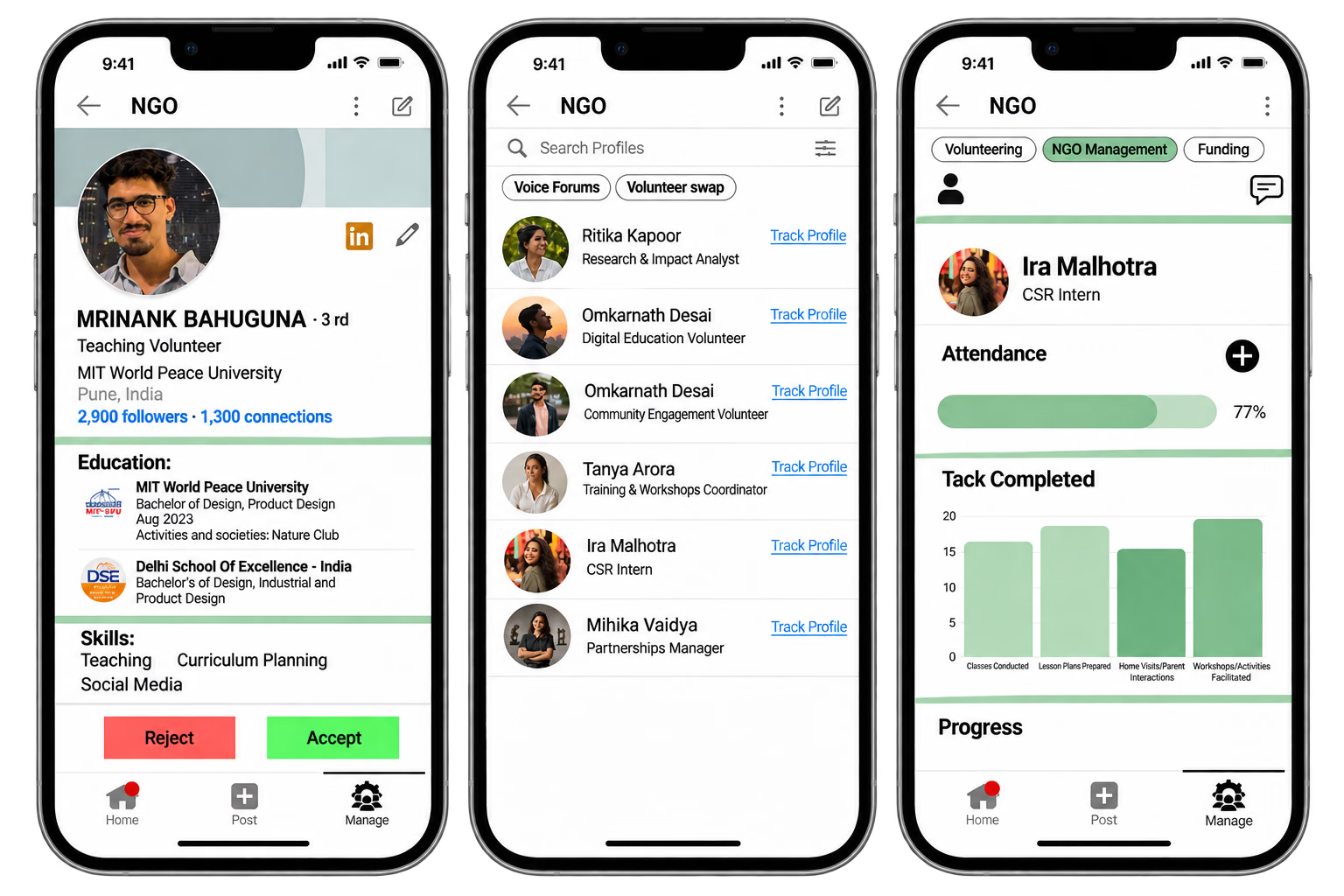
As a NGO founder or core member, you can see volunteer profile and accept or reject the profile
Easy tracking of volunteer profiles
Detailed analysis of volunteer's contribution
Fundraising
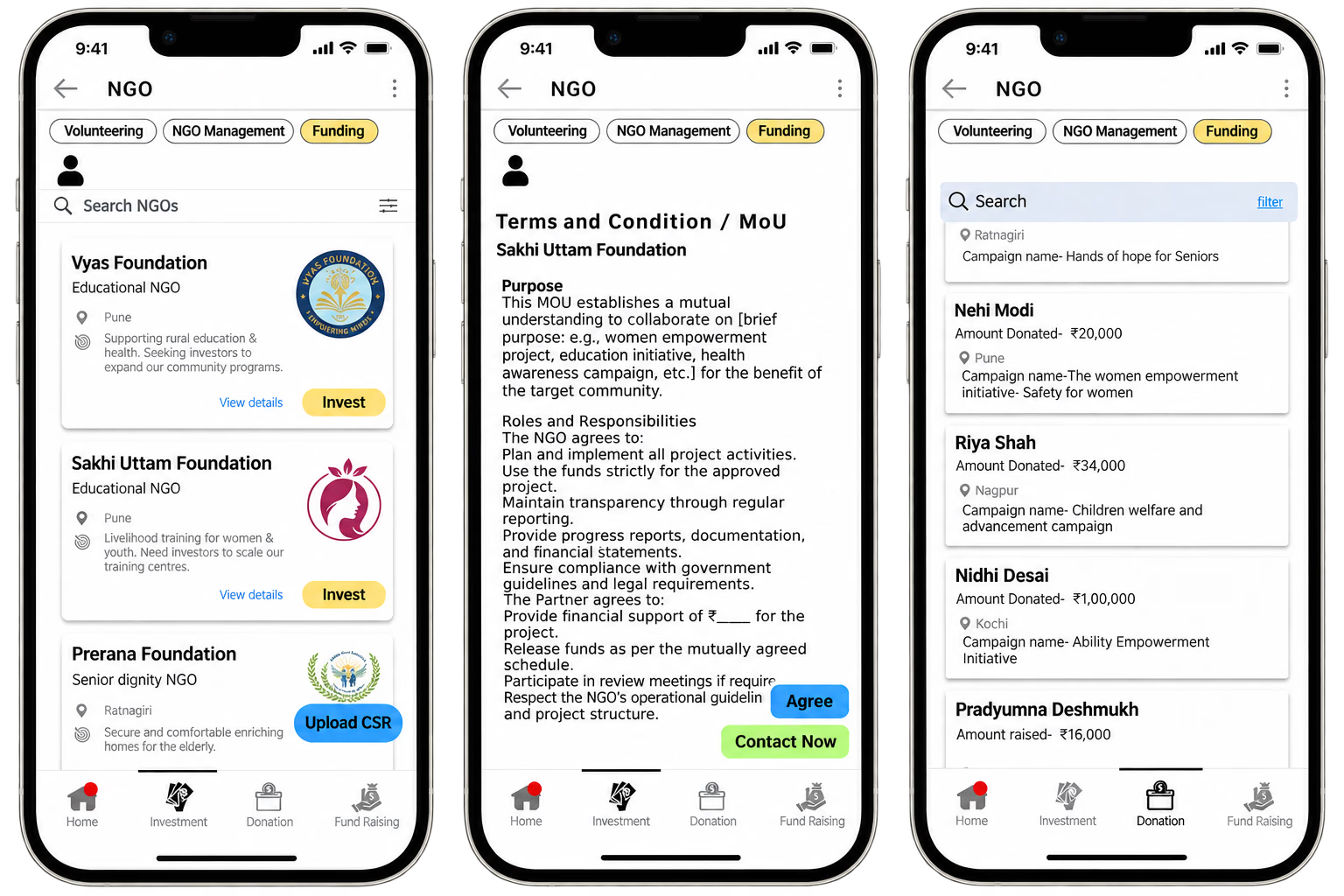
You can look at other NGO details and invest.
View details
Donors list
Volunteering brings people together to create meaningful change, with each individual contributing a unique piece to a larger mission. Within an NGO, these collective efforts become even more powerful like, uniting diverse skills, ideas, and passions to uplift communities. Together, volunteers and NGOs build impact that is far greater than what any one person could achieve alone

Curious on how the app works? Click and find out
Working prototype link
Curious about the thinking behind the project? Take a look inside.
Coffee Table Book
See other works